Seamus Fields
Launch promo ends in 00:00:00
Get the Manual — $47 $27
Seamus Fields ——— West Cork, sixty years on wet ground

Fifty old methods that out-grow modern gardening.

The cottage gardens I grew up around cost almost nothing to run and fed a family every year for fifty years. This manual is all fifty of their methods — what each one costs, how long it takes, and an honest paragraph on where it fails.

Instant download · Yours forever

50Methods
8Parts
149Pages

Seamus Fields on his ground in West Cork
"A cottage garden was never a style. It was an arrangement forced on people by small ground, hard weather, and no spare money." From Before You Begin

I · The Manual

Everything I was taught, and everything the ground taught me after.

There is a particular kind of gardening being sold now. A bag for every job, a bottle for every trouble, a new bed system every spring. It produces gardens that cost a great deal and stop working the day you stop buying.

That is not how the gardens I grew up around were run. A cottage garden was never a style — it was an arrangement forced on people by small ground, hard weather and no spare money. Everything had to earn its place. Nothing left the holding that could be used on it. The methods that came out of that arrangement are frugal, slow, and stubbornly effective, and most of them have been quietly dropped in the last sixty years because there was nothing in them for anyone to sell.

"I am not going to tell you that the old way is always the better way. It is not. But a garden that costs nothing to run and feeds a family for fifty years is a different thing entirely."

So I wrote them down. Fifty of them, grouped into eight parts, each one walked through the way one person walks another through a job at their elbow. Where a job needs materials, I tell you what they cost. Where it needs time, I tell you how much. And near the end of most chapters there is a paragraph about limits — where the method fails, and when you should call somebody who knows more than either of us.

That paragraph is the most useful part of the book, and it is the part most gardening writing leaves out. A method that works on free-draining ground in Wexford may drown a garden in Leitrim. I would rather you knew that before you dug.

II · The Difference

The bought garden, and the one that keeps itself.

Most gardening advice sells you the solution. The cottage method makes the garden produce it. Here is the same list of jobs, done both ways.

The way it's sold to you now
The way it was done here
A bottle of tomato feed every fortnight, all summer
A barrel, a bag of nettles and rainwater — Chapter 8
Bagged compost, delivered, year after year
Four pallets and the leaves off your own trees — Chapters 10 & 11
A soil test kit posted to a lab
A jam jar, a pinch of salt and two days on a windowsill — Chapter 2
A solid fence that the next gale flattens
A shelter belt that slows the wind instead of stopping it — Chapter 15
Slug pellets, and a new box every spring
The night walk, the grit ring, and one honest chapter on what actually works — Chapters 33 & 34
New seed ordered every January
A tin of your own seed, tested and traded — Chapters 21 & 26
A fridge full of vegetables bought back in February
A clamp, a rope of onions and apples in the loft — Chapters 39–41
Costs that repeat every single season
Methods that cost once and run for thirty years
III · What's Inside

The full contents — fifty methods, eight parts.

Read it in any order. The contents group the fifty methods by the trouble they fix, so you can go straight to the one you are most tired of.

Part I

The Ground

  1. The Lazy Bed: The Ridge That Beat The Wet
  2. Reading Your Soil With A Jam Jar And A Spade
  3. Seaweed: The Coast Road Fertiliser
  4. Sand, Grit And Ash: Opening A Heavy Clay
  5. The Sunken Path And The Raised Bed
  6. Lime, And When Not To Use It
  7. Never Crop The Same Ground Twice: The Old Rotation
Part II

Feeding Without Buying

  1. The Nettle Barrel
  2. Comfrey: The Plant That Feeds The Garden
  3. The Cold Heap And The Hot Heap
  4. Leaf Mould: One Bag, Two Years, Free Compost
  5. Wood Ash: Where It Helps And Where It Ruins
  6. The Hen And The Garden
  7. Green Manure Through The Irish Winter
Part III

Water, Wind And Weather

  1. The Shelter Belt: Slowing Wind Instead Of Stopping It
  2. The Sod Wall And The Stone Ditch
  3. Drainage The Old Way: The Rubble Drain
  4. Watering In A Wet Country
  5. Reading The Sky, The Ground And The Hedge
  6. Frost Pockets, Suntraps And Where To Put What
Part IV

Seed And Stock

  1. Saving Your Own Seed
  2. The Chitting Box And The Seed Potato
  3. Cuttings In A Jam Jar
  4. Division: Getting Three Plants From One
  5. Layering The Old Shrubs
  6. The Seed Tin: Testing, Storing And Trading
Part V

The Cottage Beds

  1. The Cottage Garden Plan: Everything Within Arm's Reach
  2. Sowing Thick, Thinning Hard
  3. Interplanting: Two Crops In One Bed
  4. The Potato, Properly
  5. Brassicas Through A Wet Winter
  6. Flowers That Earn Their Keep
Part VI

Pests And Trouble

  1. Slugs: The Whole Honest Chapter
  2. The Night Walk, The Beer Trap And The Grit Ring
  3. Blight: Reading It Early And Cutting Losses
  4. Birds, Netting And The Barrier That Actually Works
  5. Rabbits, Hares And The Wire That Stops Them
  6. Aphids, Ladybirds And Doing Nothing On Purpose
Part VII

The Year's Eating

  1. The Clamp: Storing Roots Without A Fridge
  2. The Rope Of Onions
  3. Apples In The Loft
  4. Drying Herbs Over The Range
  5. The Hedgerow Harvest
  6. The Hungry Gap And How To Cross It
Part VIII

The Long Game

  1. Laying A Hedge
  2. The Three-Tree Orchard
  3. The Blackcurrant, The Gooseberry And The Rhubarb Crown
  4. Six Tools To Own, And How To Keep Them Sixty Years
  5. The Garden Diary Your Grandchildren Will Read
  6. What The Old Gardens Knew That Modern Gardening Forgot

And around the fifty

  • The First Fortnight — three jobs to do in the next two weeks. About €18 and four hours between them, and they do more for a struggling garden than anything else in the book.
  • Appendix A · The Garden Ledger — five ruled columns for what each method cost you and what it gave back. Two seasons of entries will tell you more about your own ground than I can.
  • Appendix B · The Cottage Year — a blank twelve-month calendar. By the third year it beats every printed sowing chart in the country, because those are averages and yours is a fact.
  • The Fiftieth Method — the closing chapter, and the one that is not numbered.
Get the Manual — $47 $27

Instant download · Yours forever

IV · Reader Results

What people have written back.

★★★★★

"The jam jar test took twenty minutes and explained six years of failure. Heavy clay, and I had been treating it like loam the whole time. I read that chapter twice and then went out and moved the whole potato bed."

Margaret D. · Co. Leitrim

★★★★★

"I put in the nettle barrel in April and have not bought a bottle of feed since. My tomatoes are the best I have had. My wife says the barrel is to live behind the shed and I have agreed to that."

Tom H. · Pacific Northwest

★★★★★

"It is the honest paragraphs that sold me. He tells you where each method fails before you spend a Saturday finding out. I have never read a gardening book that did that."

Ellen R. · Vermont

V · About

Seamus Fields

Seamus Fields

I have kept a garden in West Cork for sixty years, on the same ground my grandmother worked before me. It is a bad hill in a wet county, and it has fed a family every one of those years.

Nobody wrote any of this down. Somebody stood in a garden and showed somebody else, and the showing carried these methods across two hundred years and a good deal of hardship — and then in about sixty years of prosperity we nearly lost the lot of them.

I started the channel because the showing has thinned out. People kept asking for the whole of a thing I could only give a piece of in ten minutes, so I sat down over one winter and wrote out all fifty, with the costs, the timings, and the parts where they let you down. It is a working manual, not a picture book about Ireland.

A book is a poor second to a person at your elbow. But it is what I have, and it will do until somebody stands in your garden with you.

Seamus FieldsWest Cork, 2026
VI · Order

Sixty years of wet-ground growing, written down at last.

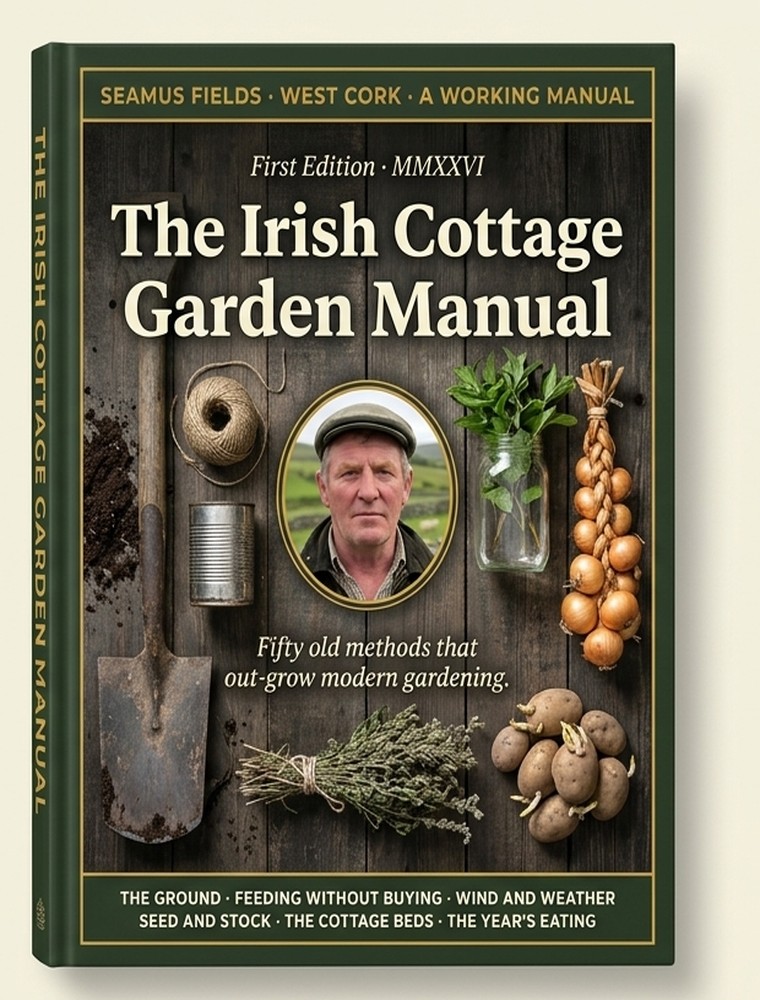
The Irish Cottage Garden Manual
Fifty old methods that out-grow modern gardening · First Edition
The Irish Cottage Garden Manual — First Edition cover
  • The complete 149-page illustrated manual (PDF), original line diagrams throughout
  • All 50 methods across eight parts — ground, feeding, weather, seed, beds, pests, storing and the long game
  • Real material costs and honest timings for every job
  • The honest paragraph in each chapter: where the method fails and when to call somebody else
  • The First Fortnight — the three jobs to do before anything else
  • Appendix A · The Garden Ledger — printable, five columns, ruled for two seasons
  • Appendix B · The Cottage Year — a blank calendar you fill in for your own ground
  • Read on phone, tablet, laptop or print it for the shed
$47$27
Launch promo · USD
Get the Manual — $47 $27

Instant download · Yours forever

Visa · Mastercard · Amex · PayPal
VII · Questions

Questions people ask me

Are these real old methods, or a nice story?

Every method in the book is one I have used, or watched used, on ground I know. They came to me the way they came to everyone before me — from somebody standing in a garden showing somebody else. Where a method is a regional habit rather than a rule, I say so in the chapter.

I don't live in Ireland. Will any of this work for me?

The climate this book is written for is mild, wet and windy with a short hard summer. If that describes your ground — Britain, the Pacific Northwest, coastal Canada, most of New England, anywhere rain rules — nearly all of it carries straight across. If you garden somewhere hot and dry, the feeding, seed, storage and tool chapters still apply; the drainage and shelter chapters will be less use to you. I would rather say that plainly than sell you a book that doesn't fit your ground.

Your videos are free. Why would I buy this?

A video gives you one method in ten minutes and no way to find it again in March. This is all fifty in one place, in the order the garden actually needs them, with the material costs, the timings, and the honest paragraph on where each one fails — which is the part that never fits in a video.

Why only $27?

Because a book about gardening cheaply should not be dear. It is a PDF, so it costs me nothing to hand you one more copy, and I would rather the methods travelled than sat behind a price nobody in a wet county would pay. $47 is what it goes to when the launch promo ends.

What format is it, and how do I get it?

A single PDF, 149 pages, delivered the moment you order. Read it on a phone, tablet or laptop, or print the pages you need and take them out to the shed. The two appendices are meant to be printed and written in.

I'm a beginner with a small garden. Is it too much?

Start with The First Fortnight at the front — three jobs, about €18, four hours. Then pick the one method that fixes the thing you are most tired of and do it properly. Do not try fifty methods in one summer; that is the surest way to end the year with fifty half-finished jobs and no dinner out of any of them.

Seamus Fields
Wait — one thing

Less than one bag of shop compost.

That is what fifty methods cost you today. Most of them cost nothing to run once they are in, and several of them will still be working in thirty years.

Get the Manual — $47 $27 or see what's inside →